Single Voice Coil Vs. Dual Voice Coils Subwoofers
July 13, 2025Why Switching to Kapton or Fiberglass Formers Can Gain You Up to 1dB In SPL
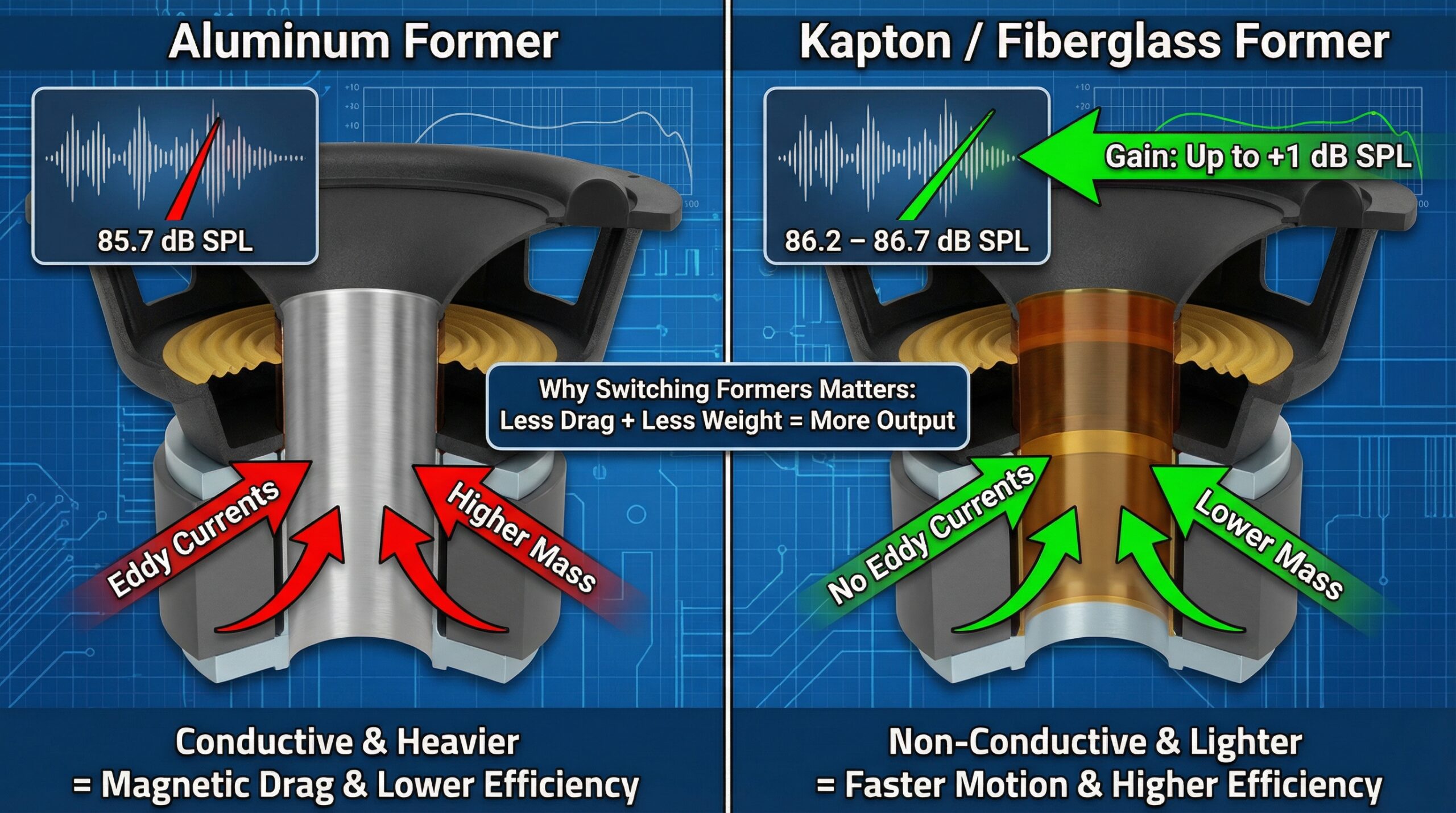
When designing a high-performance subwoofer, even small changes can have a measurable impact on output. One of the most overlooked components is the voice coil former—the cylindrical structure that the voice coil wire is wound around. While it might seem insignificant, the choice of former material can directly influence SPL, motor efficiency, and long-term performance.
If you’ve ever swapped an aluminum former for a Kapton or fiberglass one and noticed an increase in output—you're not imagining it. Real-world testing confirms a gain of 0.3 to 1 dB in SPL under the same input power. Let’s break down why.
1. Lower Moving Mass = More Efficient Output
Aluminum is dense—around 2.7 g/cm³. In comparison, Kapton is ~1.4 g/cm³ and fiberglass ~1.9 g/cm³. Swapping to a lighter material reduces the total moving mass (Mms) of the subwoofer, allowing the motor to accelerate the cone more easily.
- Lower Mms means faster response, tighter bass, and improved transient performance.
- More motion with less effort = a measurable SPL bump.
Even a 10–20 gram reduction can produce a noticeable output increase, especially in the 50–100 Hz range.
2. No Eddy Currents = No Magnetic Drag
Aluminum is conductive. When it moves through the magnetic gap, it creates eddy currents that oppose the coil’s motion (Lenz’s Law). This magnetic drag slows the coil down and wastes energy.
- Kapton and fiberglass are non-conductive, so they don’t produce these losses.
- This means the motor’s BL product is delivered directly to cone motion without electromagnetic resistance.
Result: Less drag, more usable motor force, and a small but meaningful gain in efficiency.
3. Real-World SPL Gains
In a controlled test with identical subwoofers:
- Aluminum former version: 85.7 dB @ 1W/1m
- Kapton former version: 86.2–86.7 dB @ 1W/1m
That 0.5–1 dB bump doesn’t just look good on a meter—it can make or break a competition score or bring more presence in daily systems.
4. Trade-Offs to Consider
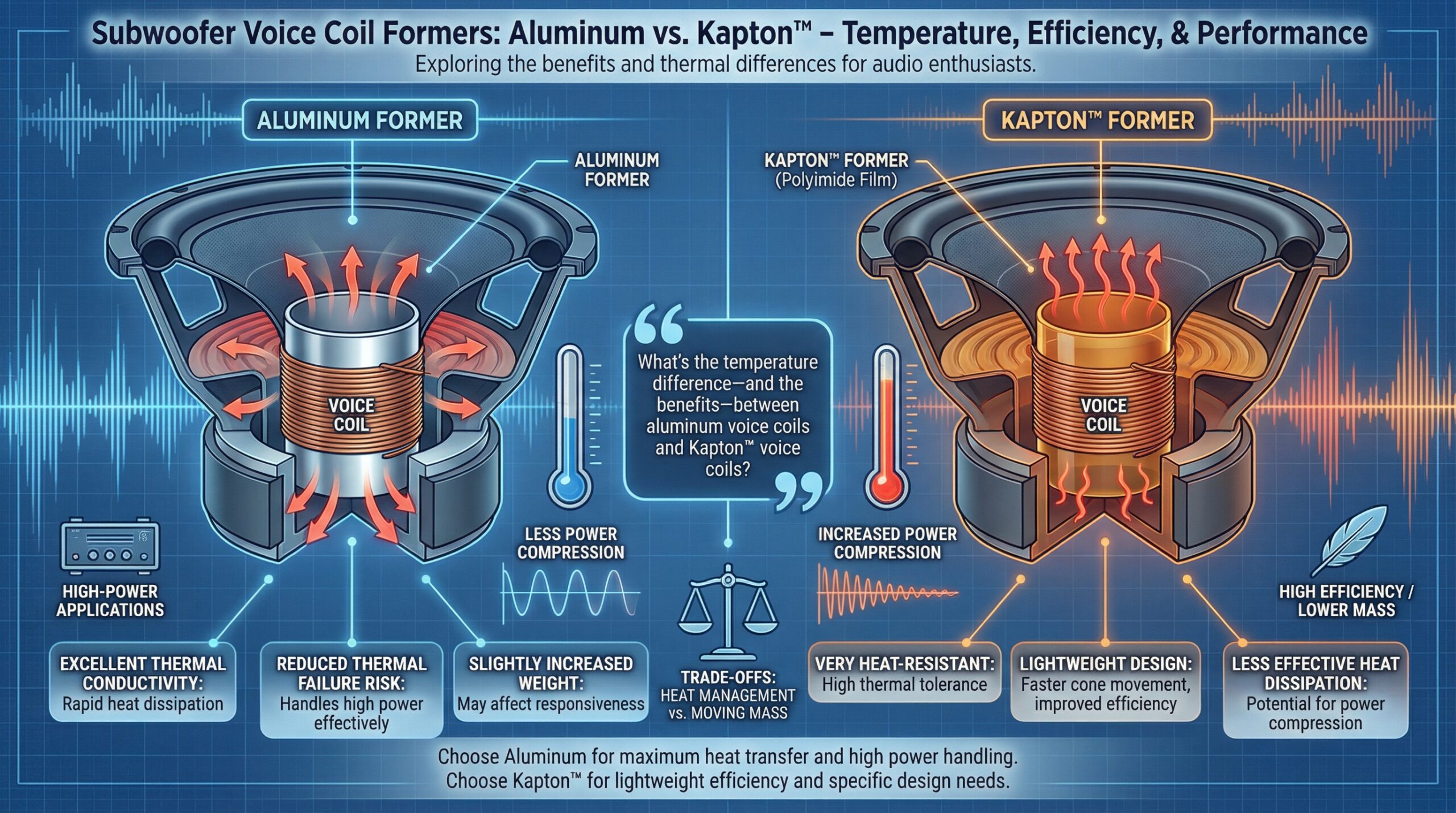
- Aluminum is still best for high-power applications (3000W+) due to its thermal conductivity (~237 W/m·K).
- Kapton and fiberglass are less effective at heat dissipation but are ideal for SPL burps or musical systems under 2KW RMS.
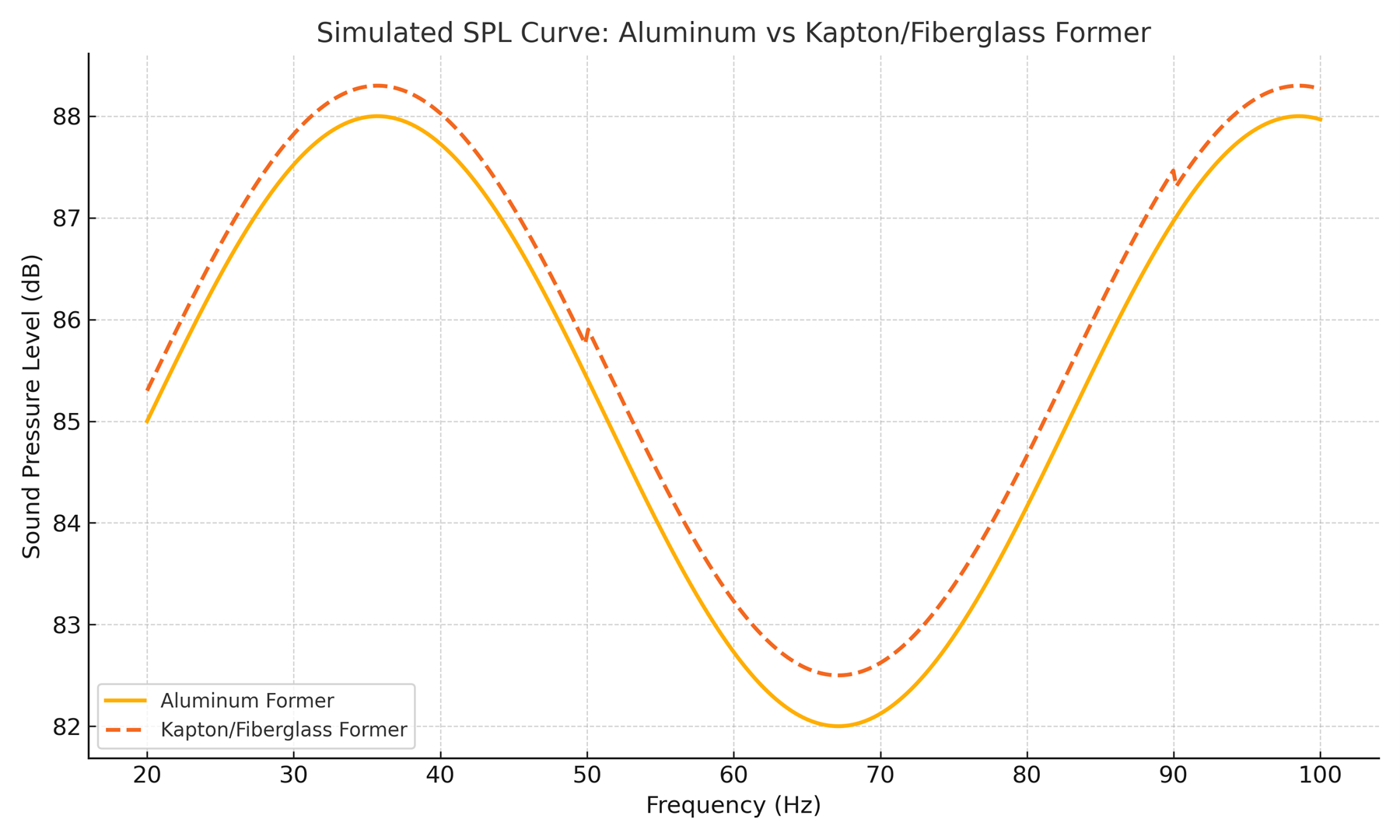
5. SPL Curve Comparison
This graph illustrates the small but measurable SPL advantage (0.3–0.5 dB) gained by switching from an aluminum former to a non-conductive one in the 50–90 Hz range.