

Temperature Differences Between Subwoofer Voice Coil Types
July 13, 2025
Why Switching to Kapton or Fiberglass Formers Can Gain You Up to 1dB In SPL
July 21, 2025Differences Between SVC and DVC Subwoofers
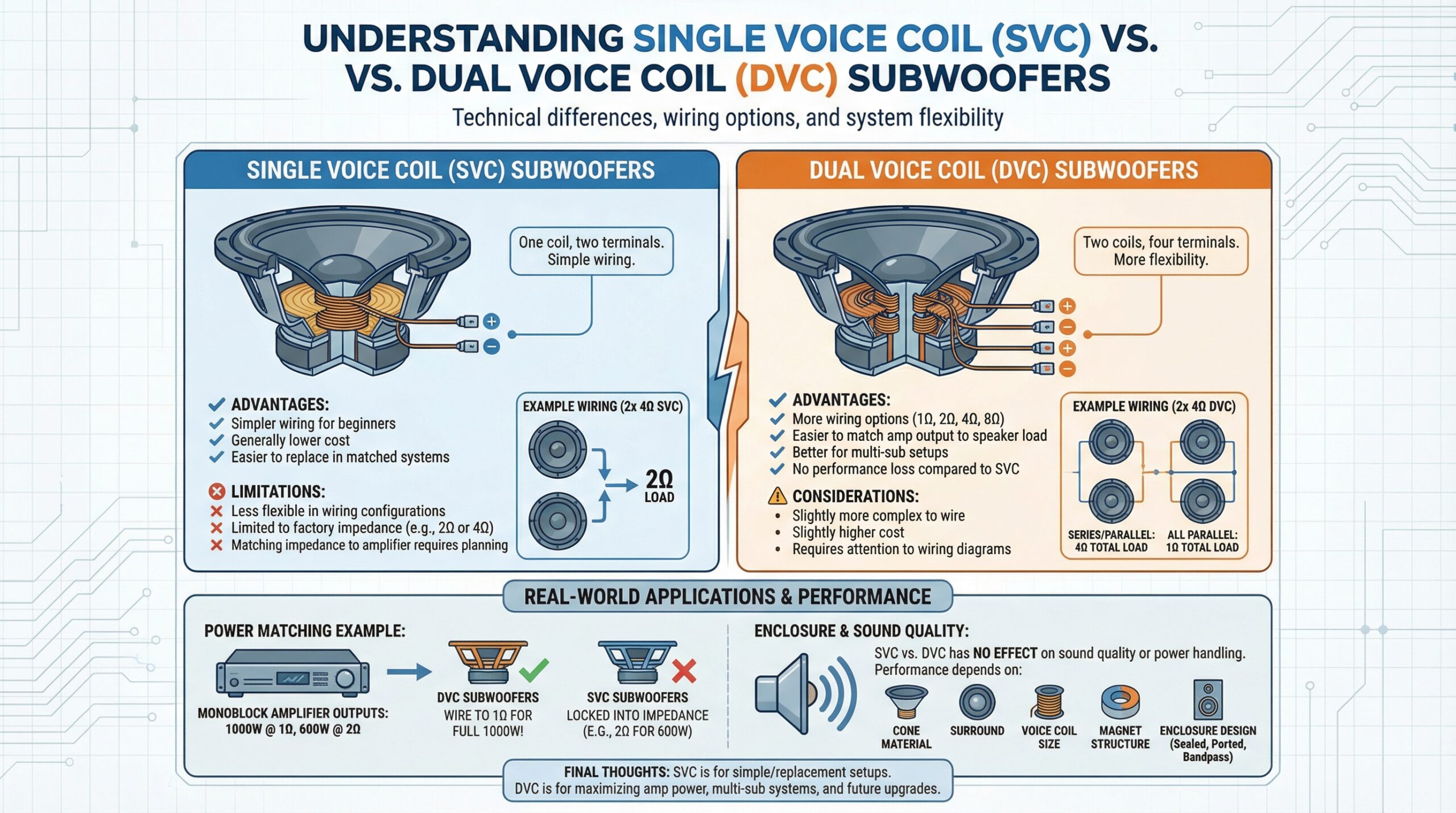
Understanding Single Voice Coil (SVC) vs. Dual Voice Coil (DVC) Subwoofers
When it comes to building a subwoofer system that performs well and matches your amplifier’s potential, one of the first decisions you’ll encounter is whether to use a Single Voice Coil (SVC) or Dual Voice Coil (DVC) subwoofer. While these two designs may appear similar on the outside, internally they offer significantly different wiring options and configuration possibilities. This article breaks down the technical differences between them and how they impact your build.
What Is a Voice Coil?
A voice coil is the heart of any speaker or subwoofer. It consists of a coil of copper or aluminum wire wound around a cylindrical former (also called a bobbin). When electrical current flows through the coil, it creates a magnetic field that reacts with the permanent magnet attached to the subwoofer’s motor structure. This causes the coil (and the attached cone) to move, producing sound.
The number of voice coils directly affects how the subwoofer can be wired — but not how it sounds. Both SVC and DVC subs can have identical power handling, cone materials, magnet structures, and frequency response. The distinction is purely about electrical flexibility.
Single Voice Coil (SVC) Subwoofers
An SVC subwoofer has one coil wrapped around its former. It comes with two terminals: one positive (+) and one negative (–). Wiring an SVC sub is straightforward and ideal for simpler systems.
Advantages of SVC:
-
Simpler wiring for beginners
-
Generally lower cost
-
Easier to replace in matched systems
Limitations:
-
Less flexible in wiring configurations
-
You’re limited to the impedance the sub comes with (e.g., 2 ohms or 4 ohms)
-
Matching impedance to the amplifier may require more planning
Example:
If you have two 4-ohm SVC subwoofers, you can wire them in parallel to achieve a 2-ohm load. You can’t wire them to 1 ohm or 8 ohms — the wiring path is fixed.
Dual Voice Coil (DVC) Subwoofers
A DVC subwoofer includes two separate coils, both mounted on the same former. Each coil has its own set of terminals — two positives and two negatives. This design allows for series or parallel wiring of the coils within a single subwoofer, offering more flexibility in achieving your desired impedance.
Advantages of DVC:
-
More wiring options (1Ω, 2Ω, 4Ω, 8Ω)
-
Easier to match amp output to speaker load
-
Better for multi-sub setups
-
No performance loss compared to SVC
Considerations:
-
Slightly more complex to wire
-
Slightly higher cost
-
Requires attention to wiring diagrams to avoid errors
Example:
Two 4-ohm DVC subs can be wired in multiple configurations:
-
Series/parallel configuration = 4-ohm total load
-
All parallel = 1-ohm total load
This makes DVC subwoofers extremely popular in car audio where amplifier output depends heavily on impedance.
Real-World Applications
Let’s say you buy a monoblock amplifier that delivers 1000 watts at 1 ohm, but only 600 watts at 2 ohms. If you use SVC subwoofers, you’ll be locked into a certain impedance depending on how they’re wired. But with DVC subs, you can adjust your wiring to bring the load down to exactly 1 ohm — squeezing the full 1000W from your amplifier.
In multi-sub systems, DVC subs give you better control when combining multiple speakers while staying within your amp’s safe operating range. Wiring two DVC 4-ohm subs to 1 ohm is easy. Doing that with SVC subs would require buying specific 2-ohm models — and even then, options would be more limited.
Enclosure and Performance
It’s worth noting that SVC vs. DVC has no effect on sound quality, frequency range, or power handling. Those qualities are determined by:
-
Cone material
-
Surround design
-
Voice coil size and material
-
Magnet structure
-
Enclosure design (sealed, ported, bandpass)
Whether you go with SVC or DVC, you must still follow the manufacturer’s enclosure volume and tuning specs to get optimal performance. An improperly sized or tuned box will ruin even the best wiring setup.
Quick Wiring Overview
| Sub Type | Example Impedance | Possible Wiring Options |
|---|---|---|
| 4Ω SVC (x2) | 4 ohms each | 2 ohm (parallel) or 8 ohm (series) |
| 2Ω SVC (x2) | 2 ohms each | 1 ohm (parallel) or 4 ohm (series) |
| 4Ω DVC (x2) | 4 ohms per coil | 1 ohm, 4 ohm, or 8 ohm |
| 2Ω DVC (x2) | 2 ohms per coil | 0.5 ohm, 2 ohm, or 4 ohm |
Final Thoughts
Choosing between SVC and DVC comes down to system goals and flexibility. SVC subs are fine for single-sub or factory replacement setups. DVC subs shine when you want to maximize your amp’s power, use multiple subs, or plan for future upgrades.
If you ever plan to scale up, or if your amplifier has a specific impedance sweet spot, investing in DVC subwoofers gives you much more headroom to adjust your system as needed — without sacrificing sound quality or reliability.
So while both types sound great, DVC is the smarter choice for serious builds, custom wiring, and high-performance car audio systems.